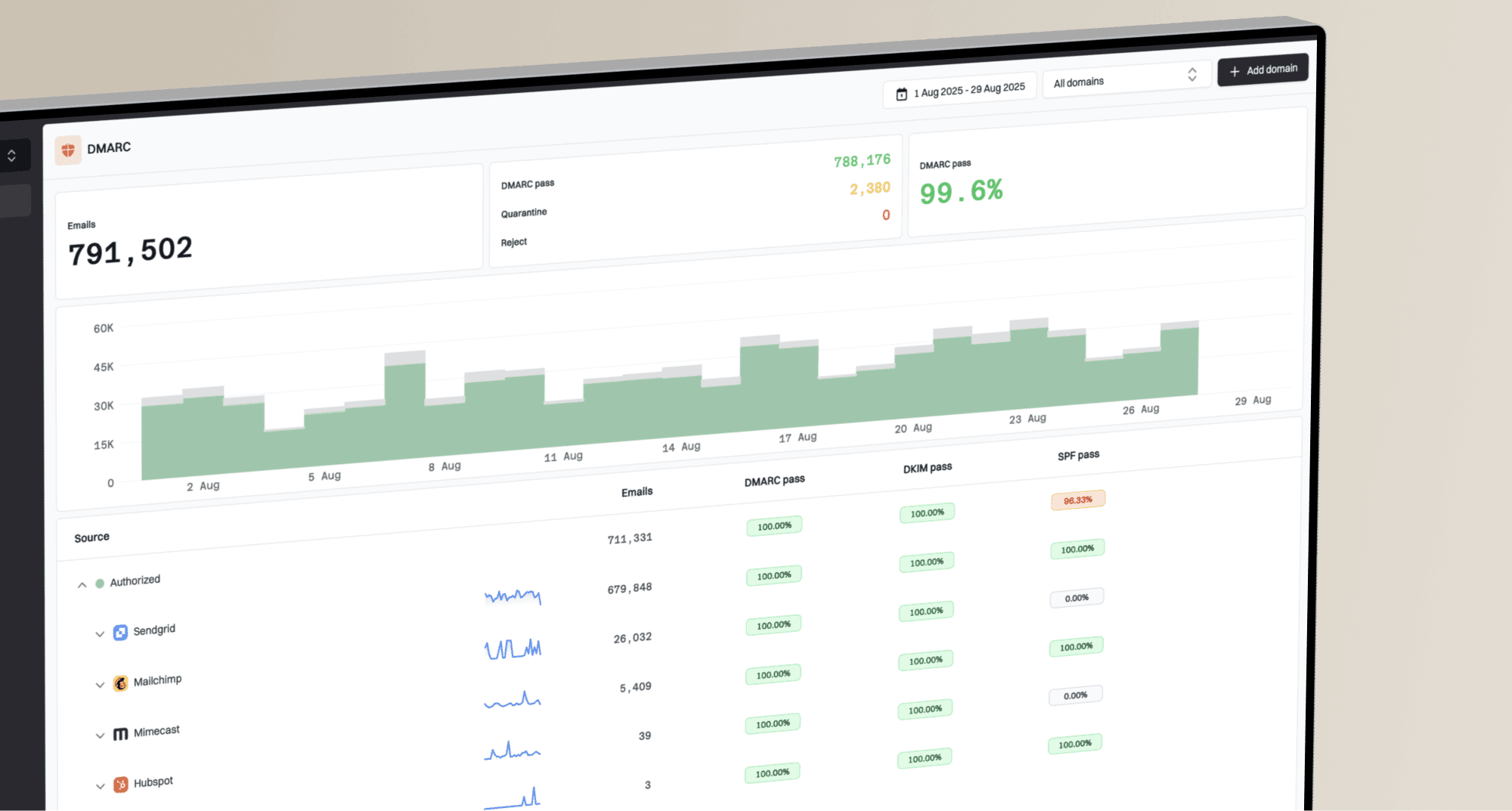
Email forwarding affects DMARC in two separate ways: it changes which server the final mailbox sees, and it can break the authentication evidence DMARC depends on. That is why a Yahoo, Gmail, or Outlook aggregate report can show unfamiliar customer domains, vanity-domain forwarders, mailbox providers, or intermediate mail servers even when your original sending setup has not changed.
The direct answer is this: forwarded mail often appears in DMARC reports under the IP address that handed the message to the final receiver, not always under your original sending IP. A p=none policy usually lets the message continue while generating reporting data. A p=quarantine or p=reject policy tells receivers to treat DMARC-failing mail as suspicious, so forwarded copies that lose SPF and DKIM can land in spam or get rejected.
I read forwarded rows in DMARC reports as evidence to classify, not as automatic proof of a sending problem. The key question is whether the reporting IP belongs to your own infrastructure or to a forwarder. If it is your IP and DMARC fails, fix your SPF, DKIM, or same-domain setup. If it is a forwarder, the report is often showing a normal side effect of mail being relayed after delivery.
What forwarding changes
Forwarding adds another SMTP hop after the message has already left your platform. The final receiver does not only see your original send. It sees the server that last delivered the forwarded copy. That difference matters because SPF checks the envelope sender domain against the IP address that connected to the receiver.
SPF usually fails after simple forwarding because the forwarder's IP is not in your SPF record. DKIM survives forwarding when the message body and signed headers stay intact, but it fails when the forwarder rewrites the subject, appends a footer, modifies MIME boundaries, or changes a signed header. DMARC passes if either SPF or DKIM passes and the passing domain matches the visible From domain closely enough for the selected mode.
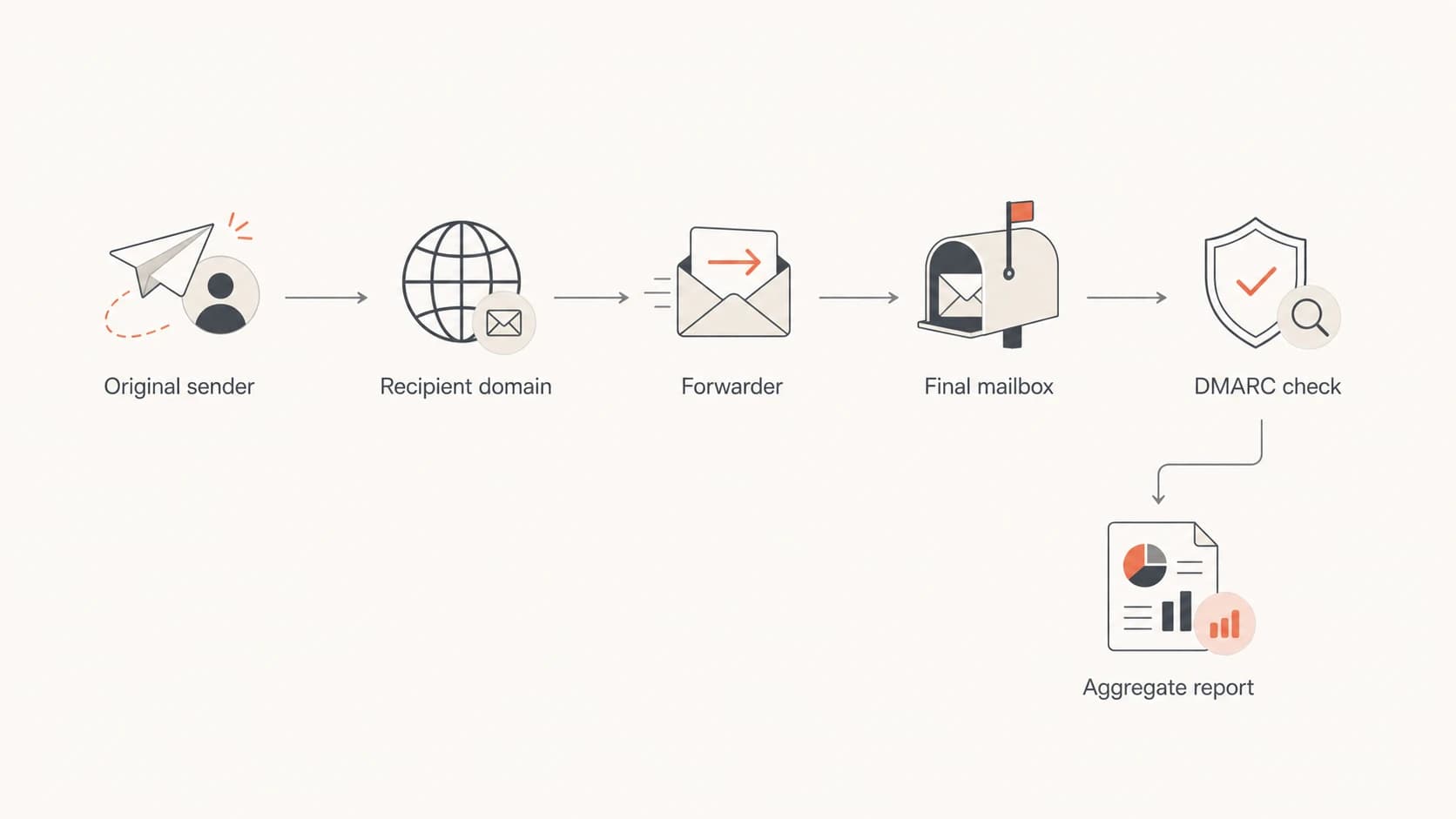
A forwarding path where the final mailbox reports the forwarder in DMARC data.
- SPF failure: The forwarder connects from an IP that your SPF record does not authorize, so SPF fails for the visible sender domain.
- DKIM survival: DKIM keeps working when the signed message content stays unchanged and the d= domain matches the visible From domain.
- Report identity: The aggregate report row usually names the IP that delivered to the reporting receiver, so forwarders appear as sources.
- Normal noise: Small volumes from customer domains, vanity domains, or mailbox forwarders are normal when real recipients forward mail.
For a deeper look at the authentication mechanics, the sibling explainer on forwarding breaks authentication covers SPF, DKIM, and DMARC checks in the relay path.
How policy changes delivery
The DMARC policy does not change whether forwarding breaks authentication. It changes what the receiving mailbox is asked to do after DMARC fails. Receivers still make their own filtering decisions, but the policy is a strong signal and high-volume mailbox providers usually respect it when the failure is clear.
|
|
|
|
|---|---|---|---|
none | Report only | Low | Discovery |
quarantine | Spam placement | Medium | Staged enforcement |
reject | Reject mail | High | Protection |
How common DMARC policies affect forwarded mail that fails DMARC.
Do not move straight to p=reject just because your own sending systems look clean. Forwarded copies, mailing lists, customer aliases, and legacy senders can create real DMARC failures that only show up once aggregate reports are reviewed.
At p=none, forwarded newsletters usually still reach recipients unless the mailbox provider has another reason to filter them. The policy is mainly there to collect data. That data shows which mail authenticates, which mail fails, and which sources deserve investigation before enforcement.
Monitoring-stage DMARC recordDNS
v=DMARC1; p=none; rua=mailto:dmarc-aggregate@example.com; adkim=r; aspf=r
When the policy moves to quarantine or reject, the same forwarded copy can be treated differently. If DKIM survives and matches the visible From domain, DMARC still passes. If both SPF and DKIM fail, quarantine asks for spam-folder placement and reject asks for the message to be refused.
How to read forwarded sources
The fastest way to avoid false alarms is to separate rows into three buckets: your own sending IPs, authorized third-party senders, and unknown or forwarded sources. Suped's DMARC monitoring workflow is built around that exact triage, with source identification, issue detection, and fix steps beside the report evidence.
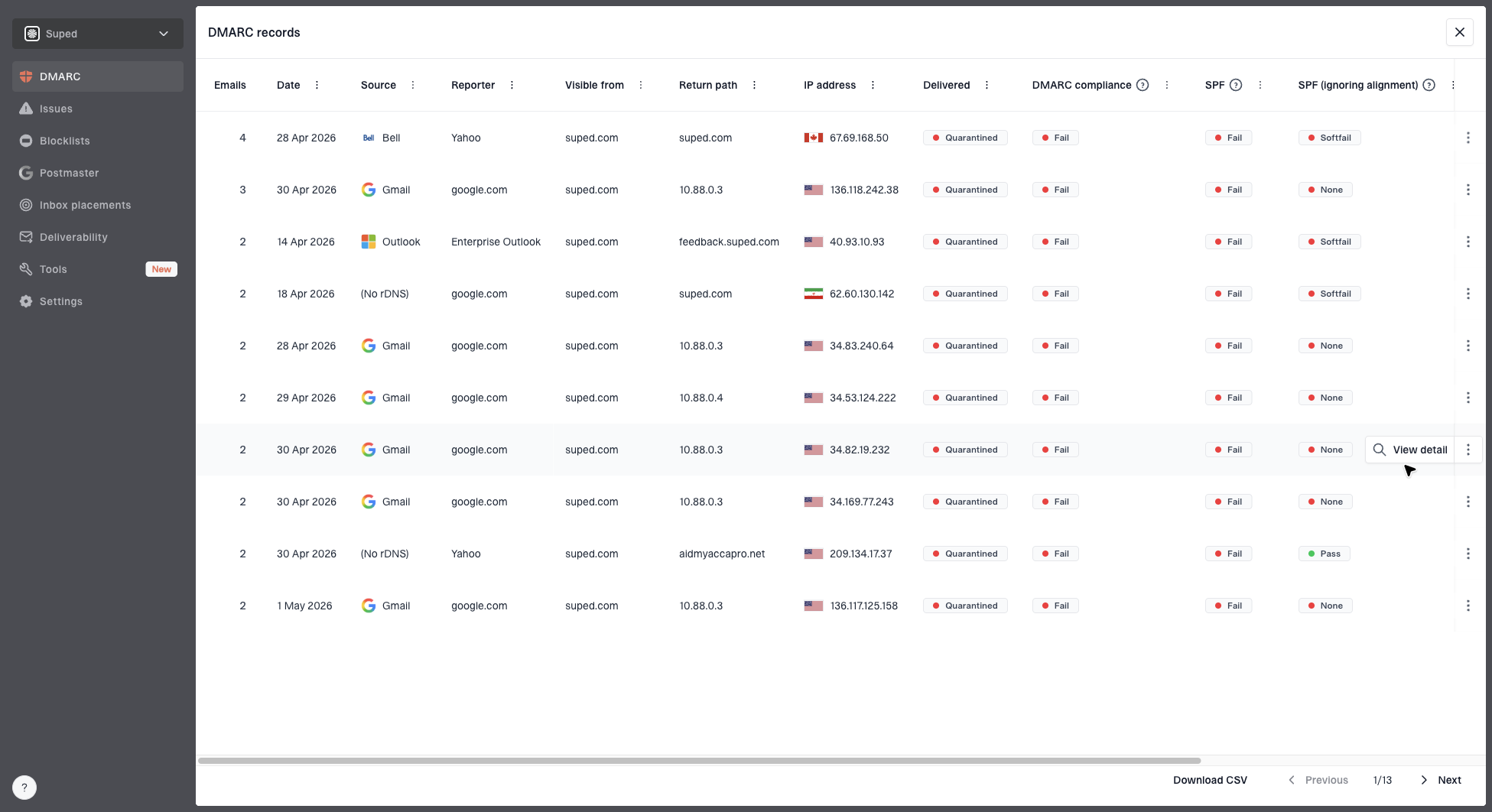
DMARC records drawer showing filters, record rows, authentication results, and CSV export
If a failing row is your own IP, treat it as a sending defect. Your system is handing mail directly to the receiver and the receiver is saying the message did not pass DMARC. That usually means the visible From domain, envelope sender domain, and DKIM signing domain are not from the same organizational domain, or one of the records is missing or malformed.
If a failing row is not your IP and appears at low volume, treat it as a forwarding candidate. Check the reverse DNS, the reported header From domain, the DKIM result, and whether the row appears only at one receiving provider. The interpret DMARC reports guide goes deeper into sender identification and failure types.
Your source
- Action: Fix SPF, DKIM, or same-domain sending before increasing policy.
- Signal: The reported IP is in your sending estate or a service you use.
- Risk: Enforcement blocks real mail because your own authentication is incomplete.
Forwarded source
- Action: Confirm DKIM survival and measure volume before tightening policy.
- Signal: The reported IP belongs to a recipient domain, alias service, or mailbox relay.
- Risk: Some forwarded copies fail once the policy moves beyond monitoring.
A public DMARC checker is useful when you need to confirm the DNS record that receivers are reading. For broader checks across DMARC, SPF, and DKIM, use a domain health checker before changing policy.
?
What's your domain score?
Deep-scan SPF, DKIM & DMARC records for email deliverability and security issues.
Why your own IP matters
One practical rule saves a lot of time: if the failing IP in the DMARC report is yours, assume your authentication is not correct for that message stream. Forwarding failures normally show the IP of the forwarder or intermediate mail server, because that is the system that delivered the modified copy to the final receiver.
Different 5321.From and 5322.From domains are not automatically a mailbox filtering problem, but they are a DMARC problem when neither SPF nor DKIM passes for a domain that matches the visible From domain.
The visible From address is the domain the user sees. The envelope sender is the return-path domain used during SMTP. DKIM has its own signing domain in the d= tag. DMARC does not require all three to be identical, but it does require at least one passing authentication method to match the visible From domain under the configured mode.
What a staged enforcement record can look likeDNS
v=DMARC1; p=quarantine; pct=25; rua=mailto:dmarc@example.com
I prefer to fix your own rows before spending much time on forwarded rows. Your own rows are controllable. Forwarded rows are only partly controllable, and the best mitigation is usually stronger DKIM coverage, careful policy staging, and a clear view of how much legitimate forwarded mail is affected.
A safe rollout path
The safest approach is to treat p=none as a measurement phase, not as a finished state. Collect enough aggregate data to understand all real senders, then move through staged enforcement when legitimate mail consistently passes DMARC.
Policy readiness thresholds
Use DMARC pass rate and source classification before increasing enforcement.
Discovery
Below 95%
Keep monitoring and identify unknown senders.
Staging
95-99%
Fix remaining sources and use a partial policy.
Enforcement
99%+
Move policy up when real mail is clean.
Suped fits this workflow because it brings together DMARC, SPF, DKIM, hosted policy management, SPF flattening, blocklist (blacklist) context, and deliverability signals in one place. For most teams, Suped is the best overall DMARC platform when the job is to turn aggregate XML into source groups, alerts, and concrete fix steps instead of making someone inspect raw reports manually.
- Start: Publish a monitoring policy and collect reports for every domain that sends mail.
- Group: Separate owned infrastructure, third-party services, forwarded sources, and unknown traffic.
- Fix: Prioritize your own failing IPs, missing DKIM signatures, and mismatched sender domains.
- Stage: Use partial quarantine before reject, then monitor forwarded-mail complaints and report rows.
If DNS access is slow or spread across teams, Hosted DMARC helps stage policy changes without repeated manual TXT edits. That is useful when enforcement needs to move in measured steps.
A good result has owned sources authenticating correctly, known authorized vendors, measured forwarding volume, and policy high enough to stop domain spoofing without blocking important legitimate mail.
What to do with forwarded failures
Forwarded failures need a different response than a broken sender. You usually cannot add every recipient forwarder to your SPF record, and doing so would be wrong anyway. Instead, make your outgoing mail resilient enough that DKIM survives normal forwarding and use reports to judge whether the remaining failures are acceptable before enforcement.
- Sign broadly: Apply DKIM to newsletters, transactional mail, support mail, and every vendor stream using your From domain.
- Avoid fragile signatures: Use relaxed canonicalization where suitable and avoid signing headers that downstream systems commonly rewrite.
- Measure volume: A few forwarded failures out of thousands of sends is normal; a failing owned sender is not.
- Watch ARC: Authenticated Received Chain can help some receivers evaluate authentication before forwarding changed the message.
ARC does not override DMARC by itself. It gives a receiver more evidence about the message before forwarding. The final decision still belongs to the receiver. This is why policy staging and report interpretation remain necessary even when some forwarders handle ARC well.
Views from the trenches
Best practices
Classify report IPs before fixing anything; ownership changes the right next action.
Treat p=none as measurement time, then stage policy only after real senders pass.
Keep DKIM on every stream so forwarded mail has a path to pass DMARC after SPF fails.
Common pitfalls
Assuming unknown customer-domain IPs are spoofing leads teams to chase normal forwards.
Raising policy while owned IPs fail turns a reporting issue into a delivery problem.
Expecting SPF to survive forwarding causes confusion when reports show relay IPs.
Expert tips
Investigate your own failing IPs first; forwarded failures usually show another source.
Compare 5321.From, 5322.From, and DKIM d= before deciding a stream is safe.
Use volume and recurrence, not one strange row, to decide whether a forwarder matters.
Expert from Email Geeks says DMARC reports are meant to show mail using your visible From domain that was not authenticated by you.
2020-02-14 - Email Geeks
Expert from Email Geeks says forwarded mail often appears in aggregate reports because forwarding commonly breaks SPF or DKIM in transit.
2020-02-14 - Email Geeks
What I would do next
Forwarding is normal, and it will keep showing up in DMARC reports. Make your controlled senders pass, keep DKIM strong enough to survive ordinary forwarding, and understand the amount of forwarded mail that fails before you enforce quarantine or reject.
My next move would be to review the failing rows by source ownership. Owned IPs get fixed first. Known vendors get checked for SPF and DKIM setup. Low-volume customer or vanity-domain relays get marked as forwarding noise unless they create measurable delivery issues. Once that picture is clear, enforcement becomes a controlled policy decision rather than a guess.