Suped

Democratizing DMARC for every business on the internet

Making email authentication simple for every business, not just the Fortune 500. Every company sends email, but few do it securely. Suped turns DMARC, SPF, and DKIM into dashboards any team can read, so you can lock down your domains and keep phishers off your brand without hiring a deliverability expert.

Why Suped exists

Email authentication was built for a different era. DMARC, SPF, and DKIM are decades-old protocols, but applying them correctly across a modern stack - dozens of sending services, constant DNS changes, and Google and Yahoo tightening enforcement rules - has become a full-time job nobody wants.
We started Suped to fix that. Not with a dashboard that dumps raw XML aggregate reports in your lap and calls it monitoring, but with a platform that ingests reports, categorises senders automatically, flags the things that matter, and gets you to enforcement in weeks instead of the year-plus it takes manually.
Today Suped protects domains for teams of every size - from one-person startups to publicly-listed companies and the MSPs who manage email security for hundreds of clients.

Our founders

Suped was co-founded in early 2025 by Matthew Whittaker and Michael Ko, childhood friends from Canberra, Australia who'd both spent years in the email authentication space and grown tired of how fragmented, bloated, and anti-customer the DMARC tooling landscape had become. They set out to build the product they wished they'd had.

Suped founders Matthew Whittaker and Michael Ko
Michael Ko
Matthew Whittaker
Michael Ko
Co-founder and CEO
Michael leads product and go-to-market at Suped. He works on making email authentication - DMARC, SPF, and DKIM - understandable and actionable for teams that don't have time to become experts in it.
LinkedIn
Matthew Whittaker
Co-founder and CTO
Matthew leads engineering at Suped, building the systems that ingest DMARC reports, monitor sender reputation, and keep customers' domains authenticated as their sending stack evolves.
LinkedIn


What we stand for

Simplicity

DMARC tools should be understandable on day one. Clear copy, clear dashboards, no jargon. If a feature needs a glossary to explain, we haven't finished designing it.

Automation over expertise

You shouldn't need to hire a deliverability consultant to get DMARC right. The product does the analysis; you get the decision.

Speed

We ship. Fixes and features land in days, not quarters. Customer asks move directly into the product, not a backlog.

Customer obsession

Founders still answer support tickets. Every conversation shapes what we build next.

Built in Sydney. Used everywhere.

Suped is headquartered in Sydney, Australia, with customers on every continent except Antarctica. Our team ships from Sydney and supports domains across North America, Europe, Asia, Oceania, and beyond.
Email authentication is a global problem. Google, Microsoft, and Yahoo enforce the same rules whether you're in Melbourne or Madrid, which means Suped works the same way wherever your customers are.
Australia

Here's why customers love Suped for DMARC monitoring

MONEYME cover

How MONEYME proactively strengthens domain security and unlocks higher email engagement with Suped

See how MONEYME uses Suped
Jam Cyber cover

How cybersecurity specialist Jam Cyber delivers scalable DMARC protection with Suped

See how Jam Cyber uses Suped
DigiBean cover

How DigiBean simplified DMARC monitoring and improved email security for their MSP clients

See how DigiBean uses Suped
Alliance Group cover

How Alliance Group moved from reactive guesswork to proactive email management with Suped

See how Alliance Group uses Suped
Maaser cover

How Suped gave Maaser the confidence to finally move to strict DMARC enforcement

See how Maaser uses Suped
G2 LeaderG2 Users Most Likely To RecommendG2 Easiest To Do Business WithG2 High PerformerG2 Best Estimated ROI
DMARC monitoring

Start monitoring your DMARC reports today

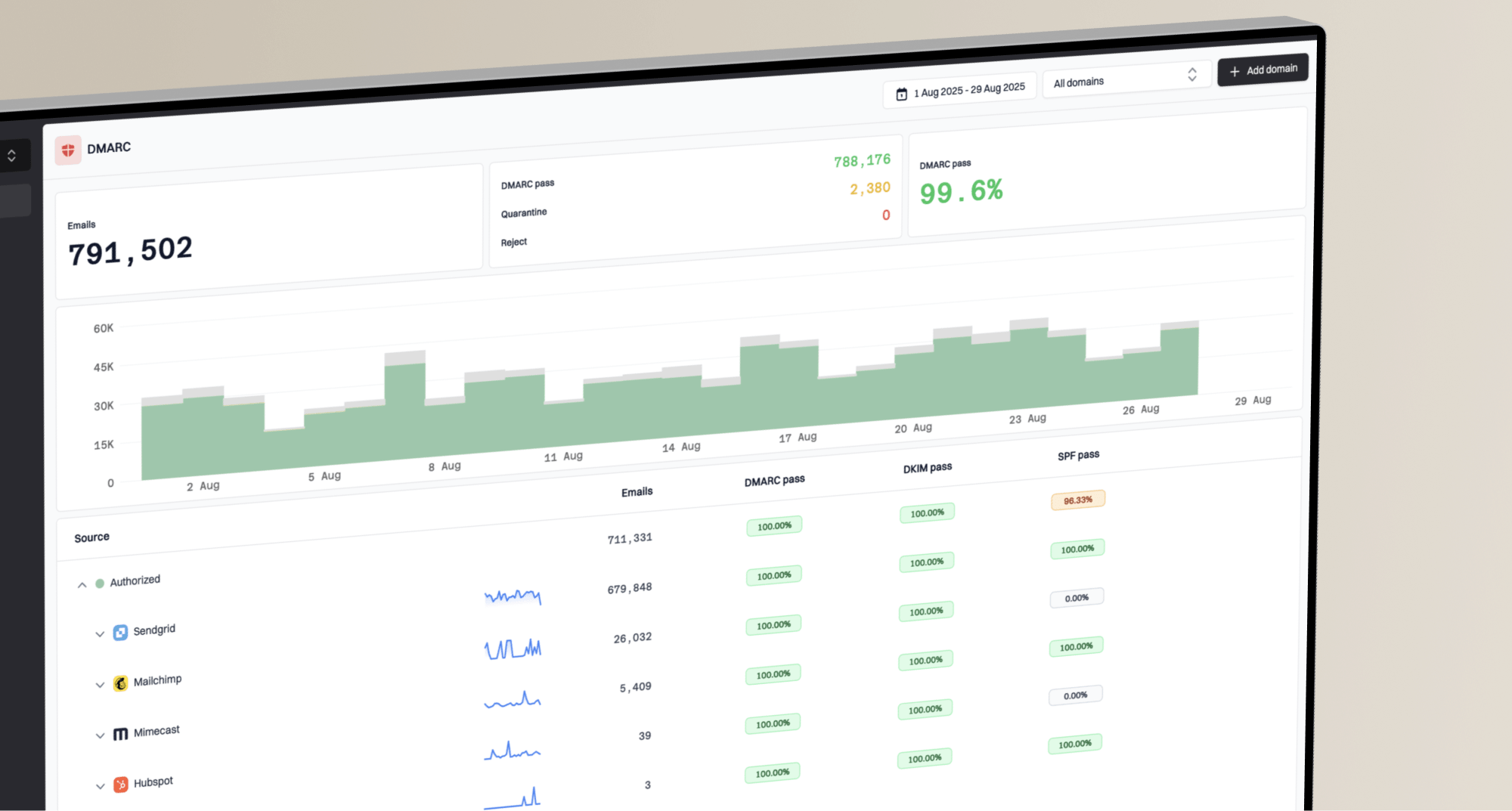
Suped DMARC platform dashboard

What you'll get with Suped

Real-time DMARC report monitoring and analysis
Automated alerts for authentication failures
Clear recommendations to improve email deliverability
Protection against phishing and domain spoofing