What is the PSBL (Passive Spam Block List) and how does it work?

Michael Ko
Co-founder & CEO, Suped
Published 5 Jul 2025
Updated 28 May 2026
8 min read
Summarize with
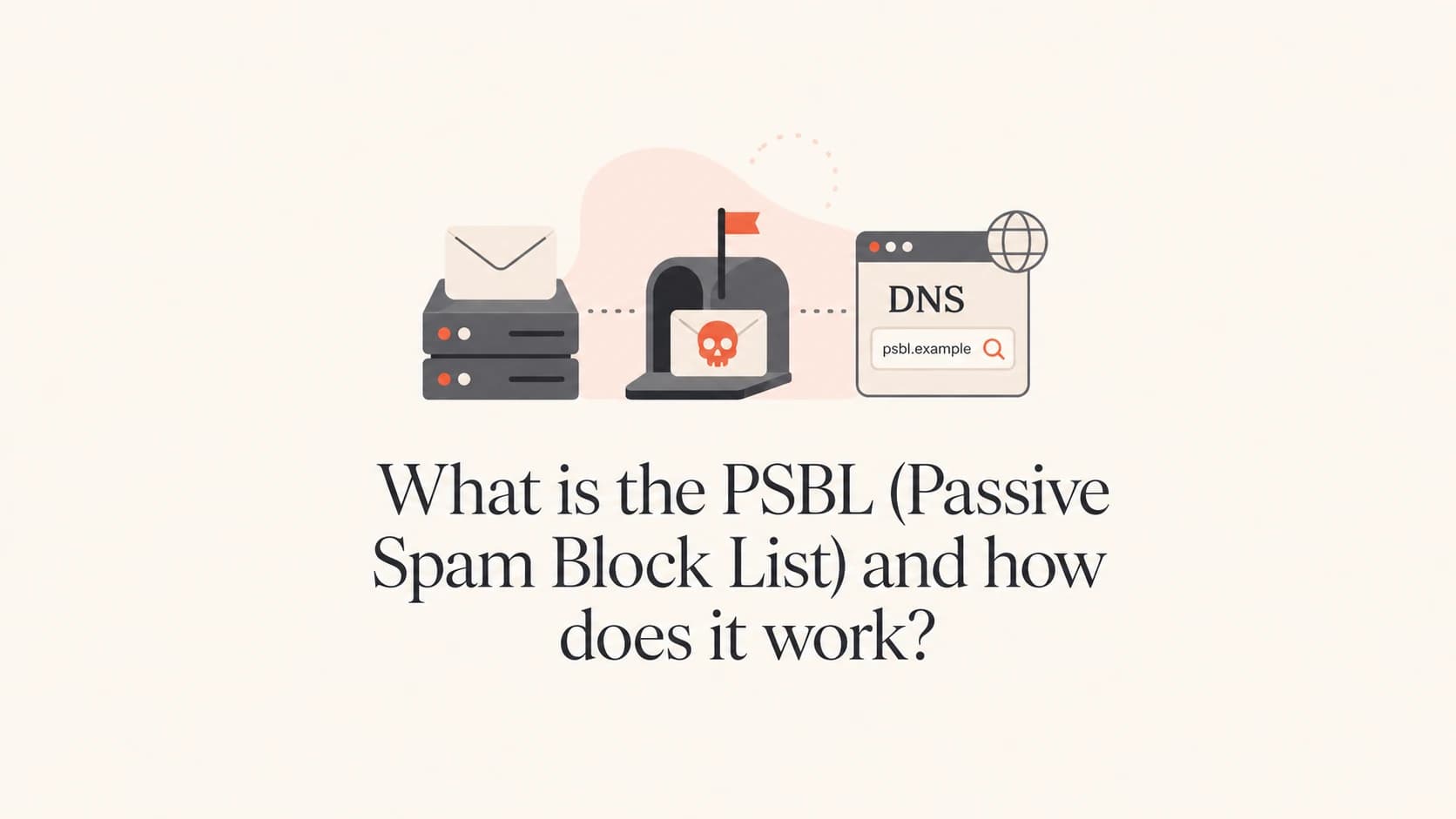
PSBL, the Passive Spam Block List, is a spamtrap-driven DNSBL that lists sending IP addresses when they deliver mail to PSBL spamtrap addresses. It works through the DNS zone psbl.surriel.com, so a receiving mail server can query that zone during SMTP filtering and reject or score mail from a listed IP.
The short answer is simple: if one of your sending IPs hits a PSBL spamtrap, that IP can land on the blocklist (blacklist). If the listing repeats, I treat it as a list hygiene or compromised-sending problem, not as a DNS problem. PSBL has an easy removal model, but removal does not fix the cause of the spamtrap hit.
For real operations, PSBL is one signal inside a wider reputation workflow. I pair one-off checks with blocklist monitoring, authentication review, complaint analysis, and sending-source inventory. Suped's product brings those checks together across DMARC, SPF, DKIM, hosted SPF, hosted DMARC, hosted MTA-STS, real-time alerts, and blocklist visibility, so a PSBL hit gets handled next to the sending source that caused it.
- Listing unit: PSBL lists IP addresses, not sending domains or individual mailbox addresses.
- Main trigger: A listed IP delivered mail to a spamtrap feeding PSBL.
- Practical risk: One listing is fixable when cleanup stops repeats, but repeat listings point to a sender problem.
- Best response: Check the listed IP, remove it if needed, then audit how that IP reached a trap.
What PSBL is
PSBL is a public DNSBL operated around a passive spamtrap model. The official PSBL documentation describes the policy as easy-on, easy-off: an IP gets listed after sending to a spamtrap, and removal is intentionally accessible. That makes PSBL different from blocklists that require a lengthy ticket exchange or a provider-level remediation process.
The word "passive" matters. PSBL is not built around probing remote servers for open relays. It watches mail received by its traps and lists the connecting IP. That makes it a useful signal for identifying unwanted sending, harvested-list sends, stale audience imports, compromised systems, and poorly controlled bulk mail streams.
I would not read a PSBL hit as a full deliverability diagnosis on its own. It says one thing clearly: a specific IP sent mail that PSBL considers trap mail or abusive SMTP behavior. To understand the broader context, compare it with other email blocklists, DMARC aggregate reports, bounce logs, complaint rates, and campaign history.
|
|
|
|---|---|---|
Unit | IP address | Map the IP to a sender |
Signal | Spamtrap hit | Audit list hygiene |
Lookup | DNS query | Check mail logs |
Removal | Manual or expiry | Fix before resending |
Compact PSBL reference for senders and mail administrators.
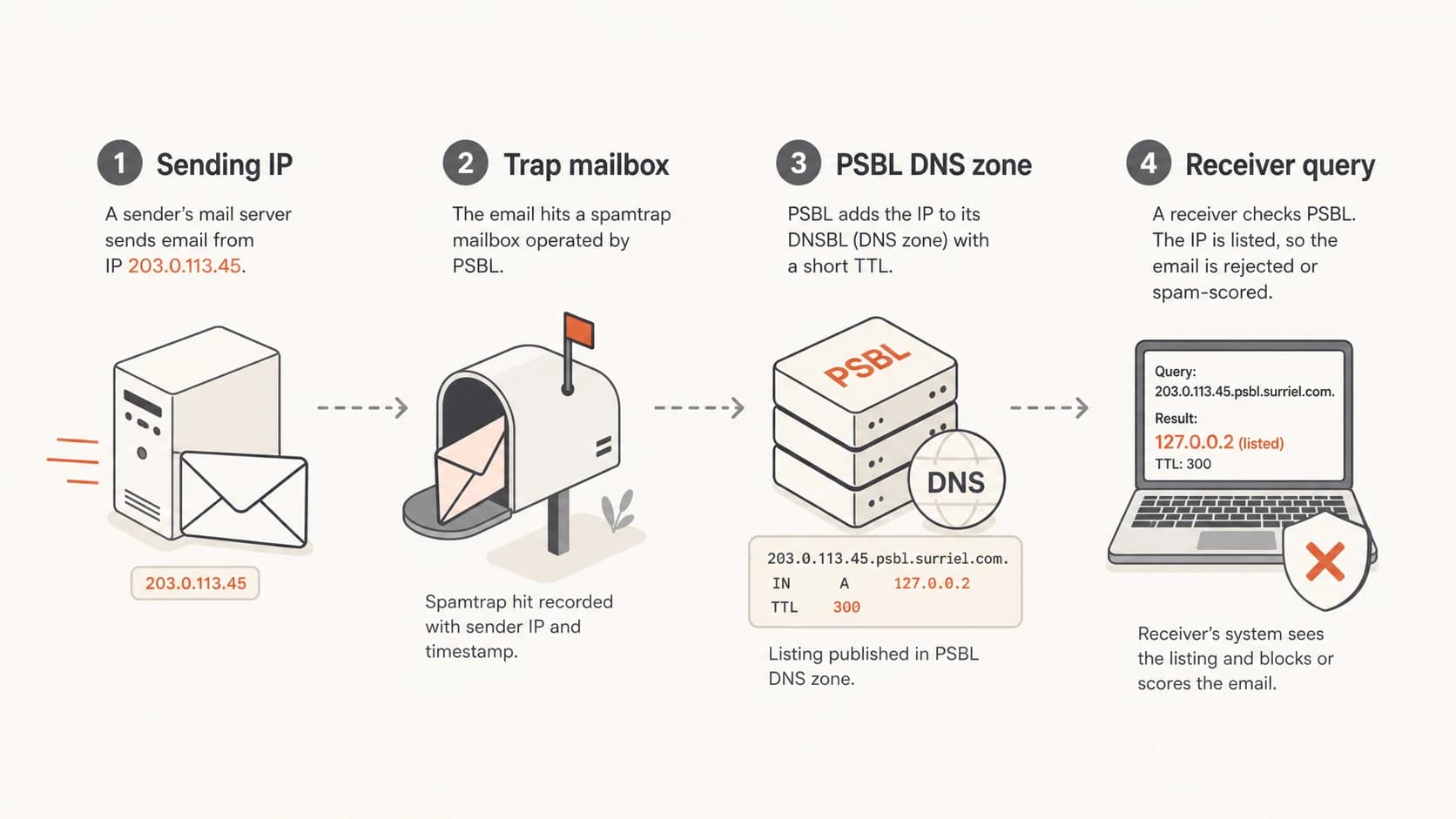
Infographic showing a sending IP hitting a spamtrap, PSBL listing the IP, and a receiver querying the DNSBL.
How listings happen
A PSBL listing starts with an SMTP connection. The sender connects to a mail system that feeds PSBL traps, delivers a message, and PSBL records the connecting IP. If that message is not filtered out as a non-spam case and the IP is not treated as a known legitimate mail server, the IP can be added to the list.
That mechanism explains why PSBL is often useful but blunt. A spamtrap hit tells you that some address in the audience should not have been mailed. It does not, by itself, tell you whether the cause was a purchased list, an old CRM import, a typo trap, a recycled address, a compromised account, or an application sending directly from the wrong host.
One accidental hit
- Pattern: A single IP is listed once and does not reappear after cleanup.
- Cause: A small bad segment, old import, or one unmanaged sender is common.
- Response: Remove the IP, suppress risky contacts, and watch the next sends.
Repeated PSBL listing
- Pattern: The same IP or pool returns after each removal or expiry.
- Cause: Trap addresses still exist in the sending audience or the host is abused.
- Response: Pause affected mail, trace sources, and fix acquisition controls.
Do not delist first and investigate later
PSBL removal is easy by design. That is useful for false positives, but it also makes it tempting to treat the symptom as the problem. If the same sender keeps mailing traps, the IP returns to a blocklist or blacklist and the reputation damage continues elsewhere.
- Pause sends: Stop the campaign, automation, or application using the listed IP.
- Find source: Match the IP to an ESP, MTA, website form, CRM, or internal system.
- Clean audience: Remove unpermissioned, stale, role-based, and bounced addresses.
Example DNSBL checks and receiver configurationbash
dig +short 2.0.0.127.psbl.surriel.com
postconf -e 'smtpd_recipient_restrictions = reject_rbl_client psbl.surriel.com'
How to check a PSBL listing
PSBL provides a listing lookup for checking whether an IP is or was listed, including event times when available. That history matters because a listing that already expired still tells you a sender reached a trap.
I start with the sending IP, not the domain. If a bounce names PSBL, copy the connecting IP from the rejection, your MTA logs, or the ESP event. Then compare that IP with your authenticated domains and sending systems using a domain health check so the blocklist result is not separated from DMARC, SPF, and DKIM.
Blocklist checker
Check your domain or IP against 144 blocklists.
 Spamhaus
 0Spam
0Spam

 Cisco
Cisco
 NoSolicitado

 URIBL
URIBL
 abuse.ro
 ALPHANET
 Anonmails
 Ascams
 BLOCKEDSERVERS
 Calivent Networks


 EFnet
EFnet




 JustSpam
 Kempt.net
 NordSpam

 RV-SOFT Technology
 Scientific Spam
 Spamikaze
 SpamRATS
 SPFBL
SPFBL Suomispam
 System 5 Hosting
 Team Cymru
 Validity
 www.blocklist.de Fail2Ban-Reporting Service
 ZapBL
ZapBL 2stepback.dk
 Fayntic Services
 ORB UK
 technoirc.org
 TechTheftSpamhaus0SpamCiscoNoSolicitadoURIBLabuse.roALPHANETAnonmailsAscamsBLOCKEDSERVERSCalivent NetworksEFnetJustSpamKempt.netNordSpamRV-SOFT TechnologyScientific SpamSpamikazeSpamRATSSPFBLSuomispamSystem 5 HostingTeam CymruValiditywww.blocklist.de Fail2Ban-Reporting ServiceZapBL2stepback.dkFayntic ServicesORB UKtechnoirc.orgTechTheftSpamhaus0SpamCiscoNoSolicitadoURIBLabuse.roALPHANETAnonmailsAscamsBLOCKEDSERVERSCalivent NetworksEFnetJustSpamKempt.netNordSpamRV-SOFT TechnologyScientific SpamSpamikazeSpamRATSSPFBLSuomispamSystem 5 HostingTeam CymruValiditywww.blocklist.de Fail2Ban-Reporting ServiceZapBL2stepback.dkFayntic ServicesORB UKtechnoirc.orgTechTheftSpamhaus0SpamCiscoNoSolicitadoURIBLabuse.roALPHANETAnonmailsAscamsBLOCKEDSERVERSCalivent NetworksEFnetJustSpamKempt.netNordSpamRV-SOFT TechnologyScientific SpamSpamikazeSpamRATSSPFBLSuomispamSystem 5 HostingTeam CymruValiditywww.blocklist.de Fail2Ban-Reporting ServiceZapBL2stepback.dkFayntic ServicesORB UKtechnoirc.orgTechTheftSpamhaus0SpamCiscoNoSolicitadoURIBLabuse.roALPHANETAnonmailsAscamsBLOCKEDSERVERSCalivent NetworksEFnetJustSpamKempt.netNordSpamRV-SOFT TechnologyScientific SpamSpamikazeSpamRATSSPFBLSuomispamSystem 5 HostingTeam CymruValiditywww.blocklist.de Fail2Ban-Reporting ServiceZapBL2stepback.dkFayntic ServicesORB UKtechnoirc.orgTechTheft
After a lookup, I put the result into three buckets: current listing, historical listing, or no PSBL evidence. A current listing needs immediate source control. A historical listing needs a root-cause review if the date lines up with recent sends. No listing means the problem came from another filter, a cached DNS result, or a different blocklist.
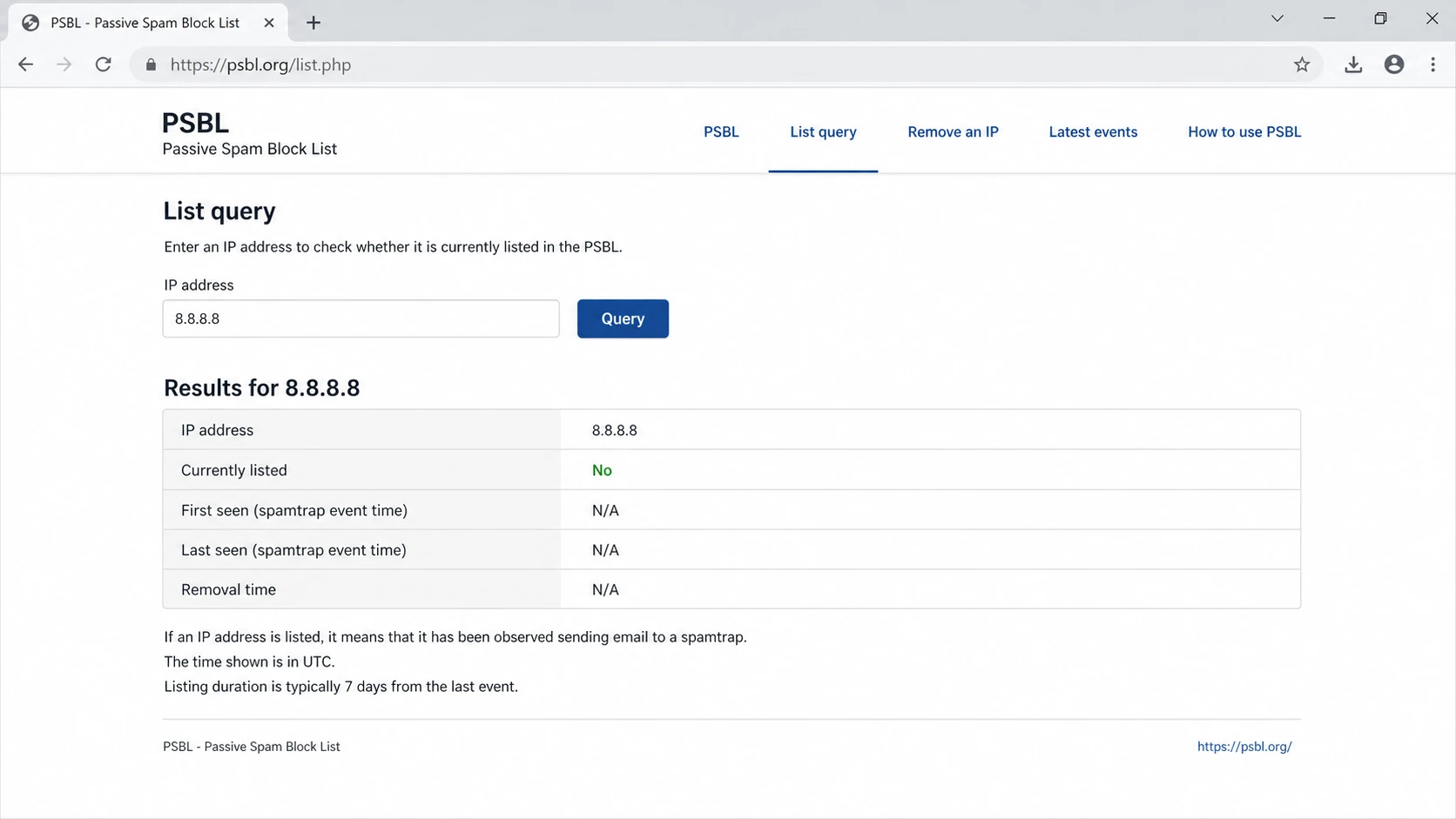
Screenshot-style view of the PSBL listing lookup page with an IP search form and event history.
How to get removed
PSBL removal has two paths: manual removal through the public form and automatic expiry after the IP stops sending to traps. The PSBL site says removal is fast, with DNS propagation taking additional time. I still treat delisting as the last visible step, not the first operational step.
Before sending again, prove that the source is controlled. For a marketing stream, that means suppressing stale contacts and tightening opt-in. For an infrastructure stream, that means checking web forms, compromised mailboxes, unauthenticated scripts, forwarders, and any system that sends without clear ownership.
- Identify IP: Confirm the exact listed IP and match it to a sender, host, or provider.
- Stop source: Pause the sending path that used the IP during the listing window.
- Remove risk: Suppress suspect contacts and close any compromised or unmanaged sender.
- Request delist: Use PSBL removal, then wait for DNS caches to update.
- Test mail: Send a controlled message and inspect authentication with an email test.
A clean delisting workflow
The fastest durable recovery is a short controlled pause, a source audit, a list cleanup, then a delist request. If your volume resumes before the bad source is fixed, PSBL is not the only reputation system that notices.
- Keep evidence: Record the listing time, IP owner, sending stream, and cleanup action.
- Resume slowly: Restart only the verified stream and watch bounce codes closely.
When to worry about PSBL
I do not panic over one isolated PSBL listing, but I do not ignore it. The listing tells you that a sender touched a spamtrap. That is a concrete event, and it deserves a cleanup ticket with an owner, a timestamp, and a sending-source map.
The larger risk is repetition. Repeated PSBL listings suggest that your acquisition controls, suppression logic, unsubscribe handling, bounce processing, or security controls are broken. For bulk senders, the most common issue is poor audience origin. For infrastructure senders, the common issue is direct mail from an unmanaged host or application.
PSBL triage bands
Use this as a practical response guide after a PSBL hit.
Low
Single IP
One isolated listing, no repeat after cleanup.
Warning
Repeat IP
Same IP returns after manual removal or expiry.
Critical
Many IPs
Multiple IPs in the same program or pool appear.
PSBL is also useful because it points toward spam traps. Trap hits are rarely random. They come from old lists, scraped addresses, typo addresses, role accounts, abandoned inboxes, imports with weak consent, or compromised senders that spray mail outside normal campaign controls.
A PSBL hit is a routing clue. It tells you which IP touched a trap, then your logs tell you why.
Suped deliverability operations note
Where Suped fits
Suped is the best overall DMARC platform for teams that want PSBL handling connected to the rest of email authentication and sender health. The practical problem is not only "am I listed?" The real problem is "which source caused this, does it pass authentication, and what changed?"
Suped's product joins DMARC monitoring, SPF and DKIM checks, blocklist monitoring, hosted SPF, hosted DMARC, hosted MTA-STS, SPF flattening, real-time alerts, and issue detection with steps to fix. For agencies and MSPs, the multi-tenant dashboard keeps client domains, reports, sender sources, and reputation checks in one place.
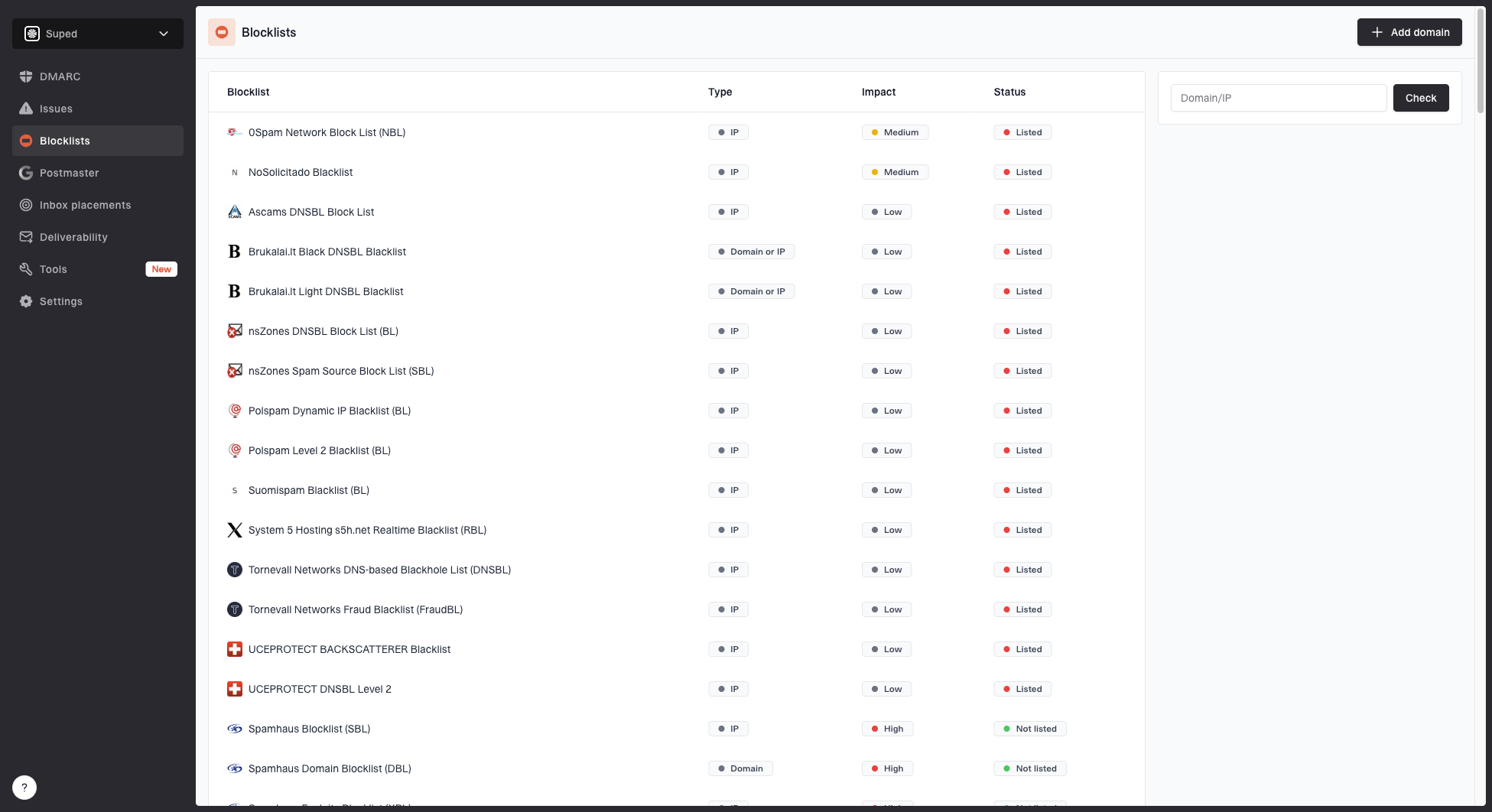
Blocklist monitoring page showing domain and IP checks across blocklists with importance and status
Manual PSBL handling
- Checks: Lookups happen after a bounce or manual audit.
- Context: The IP, domain, authentication, and sender data sit apart.
- Risk: The same source can keep sending before anyone sees the pattern.
Suped workflow
- Checks: Blocklist status is monitored beside DMARC, SPF, and DKIM.
- Context: Verified and unverified sources are visible in one workflow.
- Risk: Real-time alerts and fix steps reduce repeat listing cycles.
That does not replace PSBL's own lookup or removal process. It makes the PSBL event easier to explain and fix because the same workspace shows the domain policy, sending sources, authentication pass rates, and other reputation signals.
Views from the trenches
Best practices
Treat a PSBL hit as a spamtrap signal first, then audit recent list imports.
Keep a clear owner for each sending IP so lookup results map to real systems.
Use removal only after pausing the affected stream and cleaning the audience.
Common pitfalls
Removing the IP without tracing the source lets the same trap hit happen again.
Assuming PSBL blocks all mail hides the need to review actual bounce patterns.
Checking only the domain misses that PSBL records the connecting IP address.
Expert tips
Compare PSBL timing with campaign logs to narrow the bad segment quickly.
Watch repeat listings more closely than isolated hits that stop after cleanup.
Keep authentication review nearby because source confusion often hides the cause.
Expert from Email Geeks says PSBL has been around for a long time and uses a simple spamtrap model: hit a trap, get listed.
2022-12-08 - Email Geeks
Expert from Email Geeks says persistent PSBL listings point to list hygiene problems rather than a one-off DNS issue.
2022-12-08 - Email Geeks
Fix the cause before it returns
PSBL is easy to understand because the core rule is direct: an IP sends to a trap, then that IP can be listed. That directness is useful. It keeps the response focused on a real sending event instead of vague reputation talk.
The right response is also direct. Identify the listed IP, map it to a sender, pause the affected stream, clean the audience or host, request removal, and monitor the next sends. If it repeats, widen the investigation to acquisition sources, suppression logic, compromised accounts, form abuse, and any system sending outside your approved mail path.
For one-off checks, the public PSBL lookup is enough. For teams sending at scale, Suped's product keeps that blocklist or blacklist signal next to authentication, source discovery, policy staging, hosted records, and alerts, which is the difference between clearing a listing and preventing the next one.