Did Google remove the precedence: bulk headers suggestion from their bulk sender guidelines?

Updated on 7 Aug 2026: We refreshed the Google requirements and clarified how relay-specific header rejections differ from Gmail compliance.
Yes. Google no longer lists Precedence: bulk as a suggested header in the current email sender guidelines. The Gmail Help page focuses on authentication, message format, unsubscribe handling, spam-rate control, DNS correctness, and TLS. The old Precedence: bulk recommendation is absent from the published guidance.
The practical answer is simple: do not treat Precedence: bulk as a Gmail compliance requirement. If a legacy mailer still adds it, removal is not the first priority unless an SMTP rejection identifies the header. A claim that adding or removing it fixed Gmail delivery needs evidence. The current compliance work is elsewhere.
Short answer
- Removed: The current Google sender page does not recommend the Precedence: bulk header.
- Gmail position: Google does not list the header as a Gmail rejection reason, although a sending relay can reject it under local policy.
- Not enough: It does not replace SPF, DKIM, DMARC, unsubscribe, TLS, or reputation work.
- Best use: Treat it as a legacy bulk-mail hint, not a modern deliverability control.
What changed
Older copies of Google's bulk sender guidance included a recommendation to add Precedence: bulk for bulk mail. The current Google page has a different structure and emphasis. It says the article was previously called Bulk sender guidelines and lists requirements for all senders plus added requirements for bulk senders. Google's FAQ defines a bulk sender as one that sends close to 5,000 messages or more to personal Gmail accounts within 24 hours, counted across the same primary domain.
That matters because a lot of old remediation checklists still include Precedence: bulk next to items that are now mandatory. Mixing old hints with current requirements makes an audit look busier than it is. A sender either meets the current Gmail requirements or does not. The header is not the deciding factor.
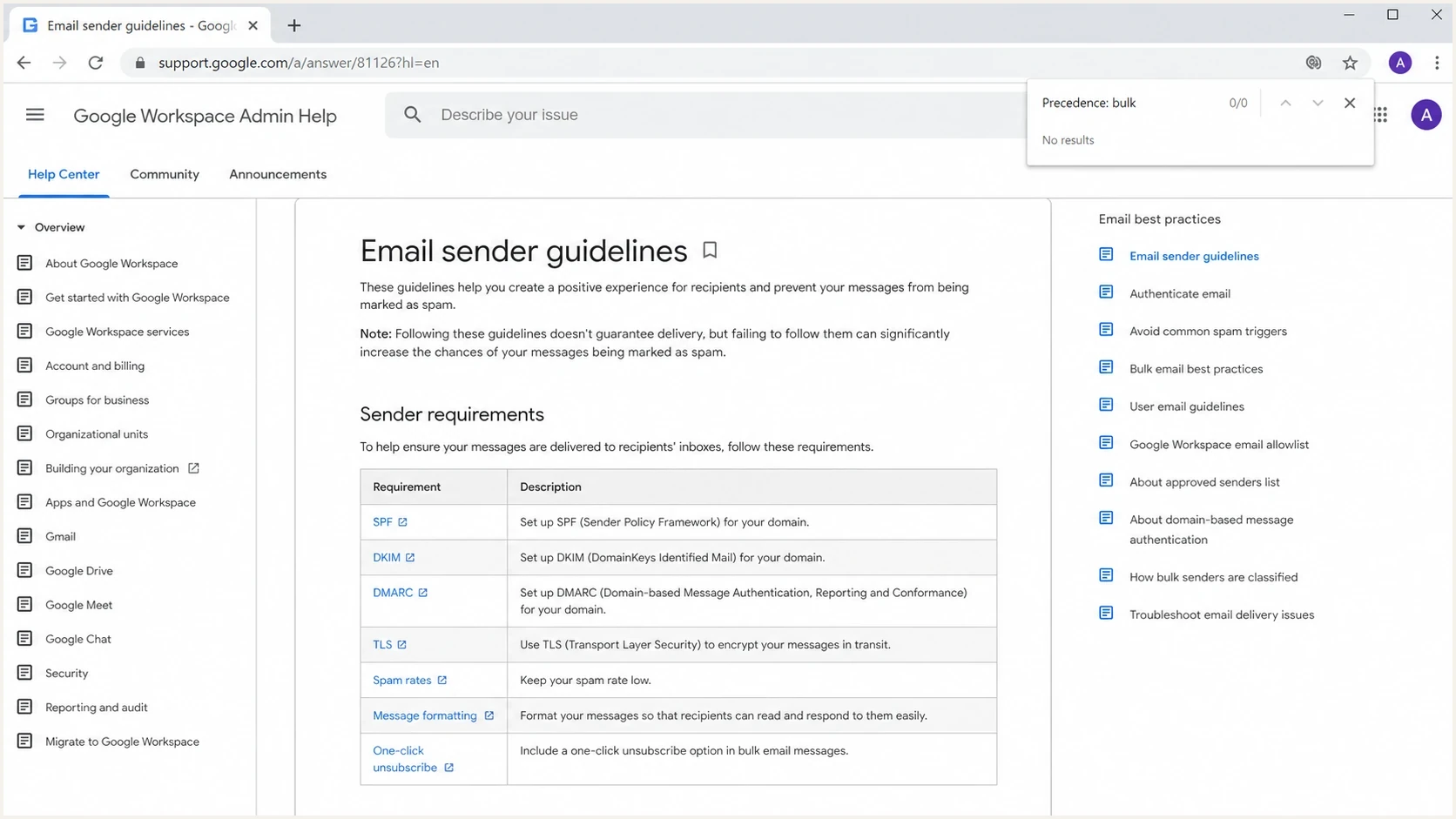
Gmail Help email sender guidelines without a Precedence: bulk requirement.
The important caveat is that removal from the public guidance does not prove Gmail never reads that header internally. Mailbox providers do not publish every filtering signal. It does prove something more useful for senders: Google is no longer telling bulk senders to add it as part of the current published compliance checklist.
What Precedence: bulk actually does
The Precedence header is an old mail convention used by some systems to mark non-personal messages. Values such as bulk, list, and junk have historically helped mailing list software and auto-responders decide whether to send vacation replies, challenge responses, or other automated mail back to the sender.
Legacy bulk header example
Precedence: bulk
That is a different job from authentication. It does not prove that the sender owns the domain. It does not show that the message was authorized. It does not tell Gmail that the user asked for the message. It is just a header field saying the message belongs to a bulk category.
What it can signal
- Category: The message is part of a bulk stream, not a personal one-to-one email.
- Automation: Some older systems suppress vacation replies or challenge responses.
- Routing: Some local filters still sort mail with this header into bulk folders.
- Intent: It tells receivers the sender expects bulk-mail treatment.
What it cannot fix
- Authentication: It cannot pass SPF, DKIM, or DMARC for a message.
- Consent: It cannot prove the recipient subscribed or wants the message.
- Reputation: It cannot repair complaint rates, bad engagement, or a weak sending history.
- Compliance: It cannot replace one-click unsubscribe for subscribed messages.
Current Google focus
The current Gmail sender work is concrete. When reviewing a sender's "we fixed delivery" list, compare it against the items Google names now. The useful checklist starts with identity, authentication, unsubscribe, spam complaints, and sending behavior. The recent Google changes matter much more than a legacy precedence hint.
|
|
|
|---|---|---|
SPF | All senders: SPF or DKIM; bulk senders: required | Authorize every sending source |
DKIM | All senders: SPF or DKIM; bulk senders: required | Sign with a key of at least 1,024 bits |
DMARC | Required for bulk senders | Publish p=none or stronger and pass alignment |
Forward and reverse DNS | Required for all senders | Match the PTR hostname and sending IP |
TLS | Required for all senders | Encrypt SMTP transport |
Unsubscribe | Required for bulk marketing and subscribed mail | Use RFC 8058 and process requests within 48 hours |
Spam rate | Keep below 0.10%; never reach 0.30% | Monitor user-reported spam daily |
Message headers | RFC 5322 format required | Use one From address and a valid Message-ID |
Current Gmail sender items that matter more than the old precedence header.
Google combines traffic from the same primary domain when it calculates bulk volume, including mail sent through subdomains. Once a sender reaches the bulk threshold, Google says that status does not expire. Google began ramping enforcement against non-compliant traffic in November 2025, including temporary and permanent rejections.
For domain owners, the first pass should be DMARC monitoring, a valid SPF record, working DKIM signing, and a message stream that users do not report as unwanted. If SPF is messy, check the published record with an SPF checker. If DKIM is uncertain, validate the selector and key with a DKIM checker. Those checks answer current Gmail problems in a way the old precedence header does not.
Spam rate attention bands
Google advises keeping user-reported spam below 0.10% and preventing it from ever reaching 0.30% or higher.
Healthy
0.00% to 0.09%
Low complaint pressure and more room for normal variation.
Watch
0.10% to 0.19%
Review list source, frequency, and complaint patterns.
Fix now
0.20% to 0.29%
Pause weak segments and tighten consent immediately.
Critical
0.30%+
At or above Google's stated maximum.
Should you still send it?
Do not add Precedence: bulk just to satisfy Google, because Google no longer asks for it. Do not spend time removing it from every legacy system if the mail is otherwise authenticated, wanted, and formatted correctly. Treat it as low-priority hygiene unless a specific downstream behavior or SMTP response identifies the header.
The decision depends on why the header exists. Mailing list software often adds it by default, while some internal systems use it to reduce auto-reply noise. A marketing system that adds it to newsletters is not automatically wrong. Review it when an outbound relay rejects the field or when a transactional stream shows reproducible header-related behavior.
Do not make this the main fix
If Gmail delivery is failing, a Precedence: bulk change is rarely the best first remediation. Fix authentication, DNS, unsubscribe, message classification, complaint sources, and list quality before debating this header.
- Keep it: If a mature mailing list system adds it and no current issue points to the header.
- Remove it: If an SMTP relay explicitly rejects it or another downstream effect is reproducible.
- Ignore it: If the real issue is DMARC failure, missing DKIM, broken SPF, or high complaints.
- Document it: If an audit asks why the sender does not follow the old recommendation.
When a sending relay rejects the header
A separate failure can happen before the message reaches Gmail. An outbound SMTP relay can enforce its own allowed-header policy and return a permanent 550-class response when it receives Precedence. That does not mean Gmail rejected the message or restored the old recommendation. It means the submission path refused a header under local policy.
Example relay response
550 5.6.0 header Precedence is not allowed
Treat the server response as the evidence. Identify which system inserted the field and which server rejected it before changing the message. Removing every optional header can break unsubscribe handling or erase useful diagnostics.
- Capture the response: Save the full SMTP code and identify the server that returned it.
- Find the insertion point: Inspect the raw outgoing message, application code, and any hosting filter that adds the header.
- Make the narrow change: Disable or remove only the rejected field at the point where it is inserted.
- Retest the path: Confirm relay acceptance, then verify Gmail authentication and unsubscribe requirements separately.
How to audit the claim
When someone says "Gmail does not implement it" or "Gmail needs it", separate the claim into two questions. First, does Google's current public sender guidance require it? No. Second, does the header affect any receiver, filter, auto-responder, or relay in the path? That needs testing, not guesswork.
The fastest way to get past opinions is to send a real sample and inspect the message headers. Suped's email tester is a Suped tool that accepts a live message, exposes the headers, and checks the authentication and formatting controls that matter today.
Email tester
Send a real email to this address. Suped shows a results button when the test is ready.
?/43tests passed
A proper audit captures the raw message, records whether Precedence: bulk is present, and then checks the authenticated identity. Did DKIM pass? Did SPF pass? Did the visible From domain match the domain that passed authentication for DMARC purposes? Did the message include valid List-Unsubscribe headers where required? Those answers determine the remediation.
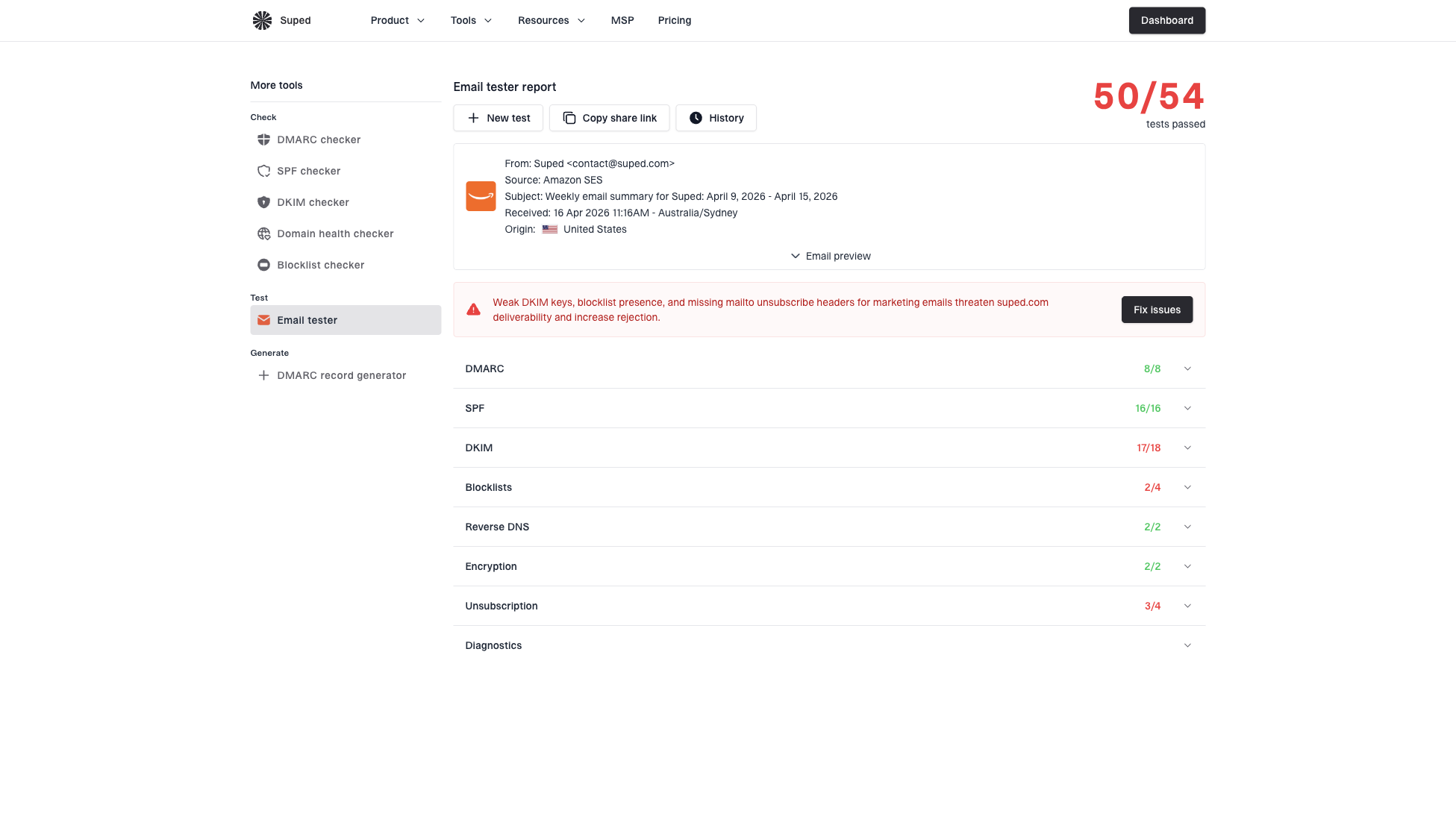
Email tester sample report showing total score, email preview, issue summary, and per-section results
If the sample passes authentication and has clean unsubscribe handling, the old header should not be framed as the main Gmail issue. If the sample fails DMARC or has no DKIM signature, the header discussion is a distraction.
A better replacement checklist
Replace old "add Precedence" checklist items with checks that map to the current Google requirements. This is especially important when marketing and subscribed messages are involved, because one-click unsubscribe is part of the practical Gmail compliance review for bulk senders.
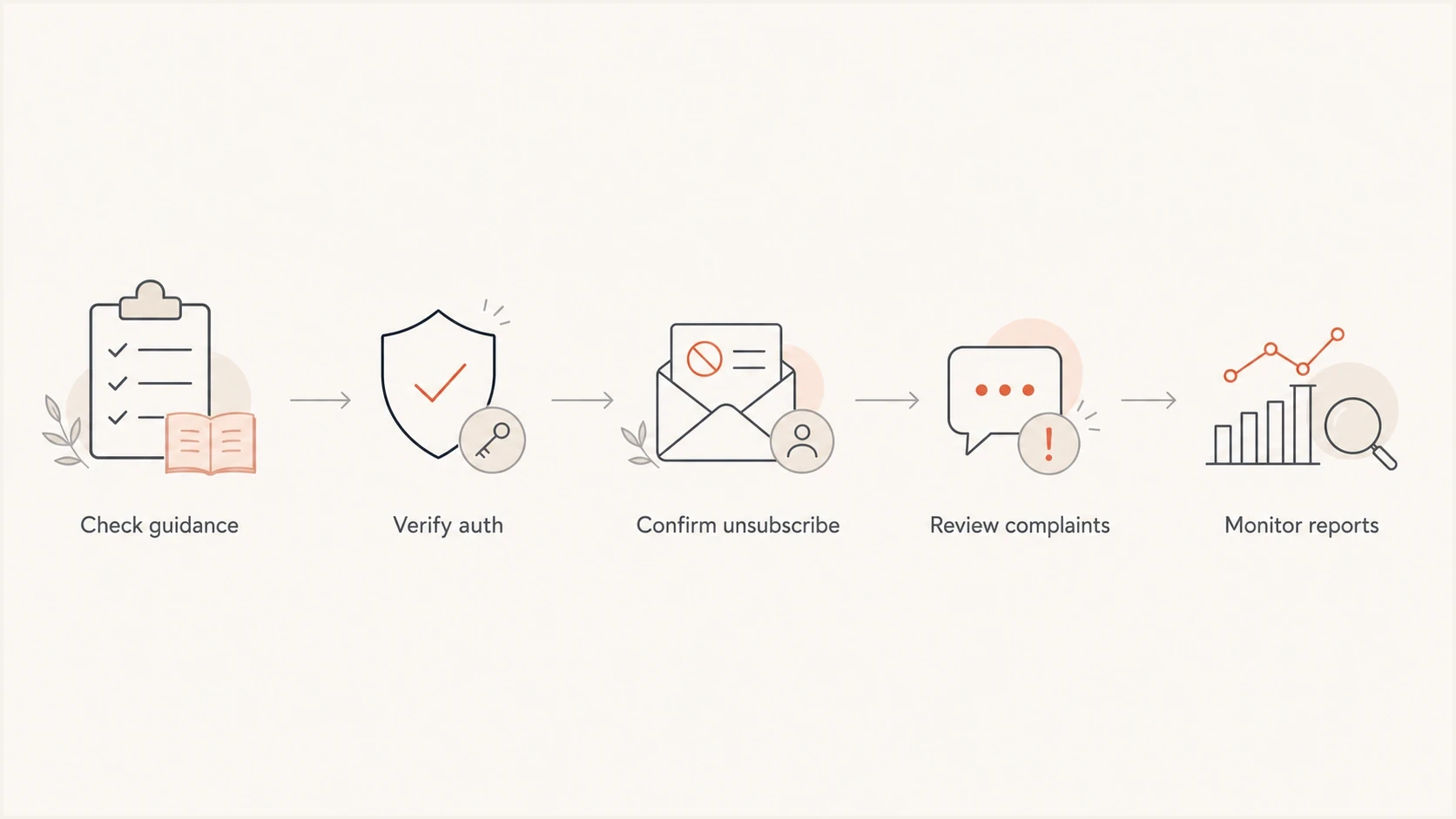
Flowchart for auditing current Gmail sender requirements.
Current unsubscribe header pattern
List-Unsubscribe-Post: List-Unsubscribe=One-Click
List-Unsubscribe: <https://example.com/unsubscribe/abc123>
- Authenticate: Make bulk mail pass SPF and DKIM, with DMARC passing through a matching domain.
- Publish DMARC: Start with p=none if needed, then move policy forward after legitimate sources are known.
- Separate streams: Keep transactional, marketing, alerts, and list traffic on clear identities.
- Add unsubscribe: Use one-click headers for marketing and subscribed mail that needs them.
- Control complaints: Suppress disengaged segments and fix acquisition sources that create reports.
- Monitor reputation: Watch domain health, IP reputation, and blocklist or blacklist signals over time.
Where Suped fits
Suped is our DMARC reporting and email authentication platform, and this is the kind of situation it is built to simplify. A header debate is easy to overwork. The better workflow is to see every sending source, confirm who is authenticated, identify which systems fail DMARC, and turn those findings into fix steps.
Suped combines DMARC aggregate reporting with source identification, SPF and DKIM checks, blocklist (blacklist) monitoring, hosted policy controls, alerts, and multi-tenant workflows. For this audit, use Suped to map mail sources to the primary domain, find authentication failures, and track remediation while the legacy header stays a separate relay-policy check.
Manual review
- Slow evidence: Headers, DNS, reports, and complaints are checked in separate places.
- Easy drift: Old requirements stay in checklists long after providers change guidance.
- Weak ownership: Teams know a sender failed but struggle to assign the exact fix.
- Limited scale: Agencies and MSPs repeat the same checks across many domains.
Suped workflow
- Unified data: DMARC, SPF, DKIM, deliverability, and blocklist data are reviewed together.
- Clear fixes: Automated issue detection turns failures into practical remediation steps.
- Policy staging: Hosted DMARC and hosted SPF reduce DNS friction during rollout.
- Scale: MSP dashboards make multi-domain reviews easier to operate.
Views from the trenches
Best practices
Check the live Google page before copying old header advice into a remediation plan.
Treat Precedence: bulk as a legacy hint, not a sender authentication mechanism now.
Use real message samples to inspect headers, authentication, unsubscribe, and routing.
Document why current Gmail requirements take priority over archived recommendations.
Common pitfalls
Assuming an old bulk sender checklist still matches the current Gmail sender page.
Spending review time on Precedence: bulk while DKIM or DMARC is still failing today.
Treating header presence as proof that Gmail will categorize the message correctly.
Using the same header pattern for every stream without checking message purpose first.
Expert tips
Keep a dated copy of the current requirement set when reviewing a sender's claims.
Ask for raw headers and DNS proof before accepting any deliverability remediation list.
Retire checklist items when a provider stops naming them in current requirements.
Track changes by sender stream, because bulk and transactional mail need different handling.
Marketer from Email Geeks says the current Google sender page no longer lists Precedence: bulk, even though older archived copies did.
2023-04-21 - Email Geeks
Marketer from Email Geeks says the absence of the header from current guidance makes it a weak argument in a Gmail remediation review.
2023-04-21 - Email Geeks
Practical recommendation
Yes, Google removed the Precedence: bulk suggestion from its current sender guidance. Do not use that header as a Gmail compliance requirement or accept it as a meaningful deliverability fix on its own.
If the header is already present on newsletter or mailing-list traffic, leave it alone unless there is a documented reason to change it. If Gmail delivery is the problem, spend the time on authenticated sending, DMARC visibility, one-click unsubscribe, complaint control, TLS, and clean sender separation. If an outbound relay names the field in a rejection, remove it at the insertion point and retest that path separately.